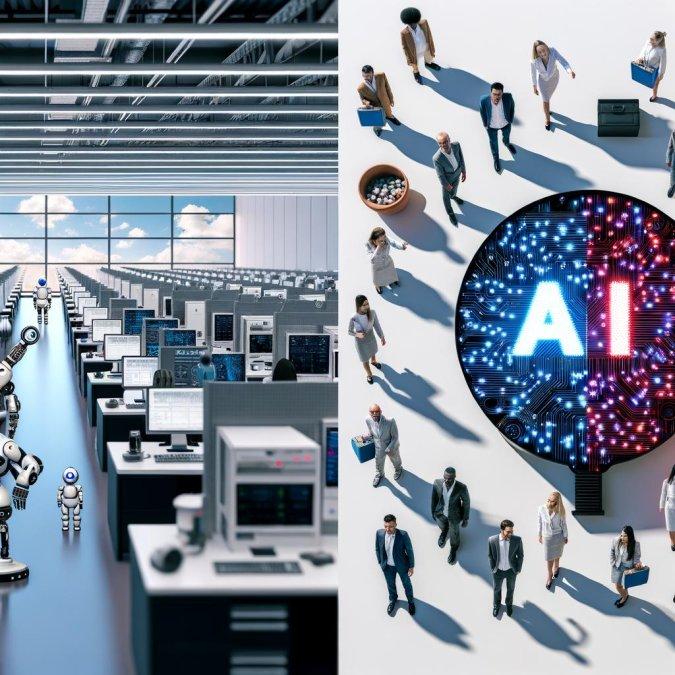
Will AI replace your workforce-or make it unstoppable? For business leaders, this is no longer a future debate but a present operational decision with real consequences for cost, speed, and competitiveness.
AI can process data, automate routine tasks, and scale output faster than any human team. But judgment, creativity, trust, and complex decision-making still depend heavily on people.
The real question is not AI versus humans, but where each delivers the highest value. Companies that understand this balance are cutting inefficiencies while building stronger, more adaptable organizations.
Before investing in automation or restructuring teams, leaders need a clear view of what AI does well, where human talent remains essential, and how the two can work together without creating new risks.
AI vs Human Workforce: Key Differences, Strengths, and Business Impact
What actually separates AI from human labor in day-to-day operations? Not speed alone. The sharper distinction is consistency versus judgment: AI handles high-volume, rules-based work without fatigue, while people step in when context shifts, trade-offs matter, or the data is messy in ways a model cannot reliably interpret.
In practice, that difference shows up fast inside workflows. A support team may use Zendesk AI to classify tickets, draft replies, and route routine cases in seconds, but experienced agents still handle billing disputes, retention conversations, or any case where tone, policy exceptions, and customer history collide. That’s where businesses either protect revenue or lose it.
- AI strengths: throughput, pattern detection, 24/7 availability, and process compliance across repetitive tasks.
- Human strengths: negotiation, ethical judgment, creative problem framing, and reading signals that never made it into the system.
- Business impact: lower handling time, fewer manual errors, and a redesign of roles rather than a simple headcount swap.
One quick observation: companies often overestimate how much “knowledge work” is fully automatable because they only map visible tasks, not the invisible ones. The escalation call, the exception approval, the hallway clarification, the client relationship repair-those are rarely captured in the process diagram.
It matters. In finance teams, for example, AI can extract invoice data with tools like UiPath or Microsoft Copilot, but a controller still decides whether a vendor anomaly is fraud, sloppiness, or a one-off timing issue. The commercial lesson is simple: use AI to compress routine workload, then shift human capacity toward decisions that carry risk, trust, or margin.
How Businesses Should Divide Work Between AI Systems and Human Teams
Start with the work, not the technology. Break each role into decisions, exceptions, and handoffs, then assign AI to high-volume pattern work and people to judgment-heavy moments. In practice, teams do this well when they map a process in tools like Lucidchart or a simple swimlane in Miro, marking where speed matters, where mistakes are expensive, and where context is missing.
For example, in customer support, AI can draft replies, classify tickets, and pull account history from the CRM, but escalation rules should route billing disputes, legal complaints, or churn-risk accounts to senior agents. That split usually works because the machine handles intake and retrieval, while the human handles negotiation, tone adjustment, and edge cases that never look obvious in a dashboard.
Keep one rule visible: humans own outcomes, AI owns assistance.
- Use AI for first-pass work: summarizing contracts, forecasting inventory swings, cleaning spreadsheet data, generating code tests.
- Reserve human review for approvals, policy interpretation, pricing changes, hiring decisions, and anything that affects trust.
- Build a clear fallback path when confidence is low, source data conflicts, or the AI cannot explain its result.
A quick observation from real operations: the biggest failure point is rarely the model. It is the handoff. Teams ask AI for a draft in Microsoft Copilot or ChatGPT, then no one defines who verifies facts, who signs off, or where the final version lives, so speed goes up while accountability gets blurry.
Talk to your frontline staff. They usually know which tasks are repetitive but risky in ways leadership misses. If you divide work well, AI reduces queue time and humans spend more of their day where experience actually changes the result; if you divide it badly, you just automate confusion.
Common AI Workforce Integration Mistakes and How to Avoid Costly Missteps
Most integration failures do not come from bad models; they come from bad job design. Companies drop AI into a live workflow without defining where human review starts, where automation stops, and who owns exceptions. In practice, this shows up when a sales team uses Microsoft Copilot to draft client emails, but no one decides whether account managers must approve pricing language, so inaccurate offers go out and trust gets burned.
- Automating unstable processes: If the workflow changes every two weeks, AI will only hard-code confusion. Clean up the process first, then automate the narrowest repeatable segment.
- Measuring the wrong outcome: Teams often celebrate hours saved while ignoring rework, escalation volume, or compliance exposure. Track downstream effects in Jira, ticket queues, or QA logs-not just speed.
- Leaving frontline staff out: The people handling edge cases usually know where AI will fail fastest. Bring them into prompt design, exception rules, and pilot reviews early.
One more thing. Leadership often assumes employees will “figure out” when to trust AI output, but judgment does not emerge from a policy memo. It usually requires decision trees, red-flag examples, and a visible escalation path in tools people already use, whether that is Slack, ServiceNow, or a CRM.
I have seen this firsthand: a support operation cut response time with generative AI, then quietly lost margin because agents accepted wrong refund suggestions during peak hours. The fix was not removing AI; it was adding approval thresholds, confidence-based routing, and weekly error reviews. That is the costly misstep to avoid-treating deployment as the finish line.
Summary of Recommendations
The real business advantage is not choosing AI over people, but deciding where each creates the most value. Companies that treat AI as a force multiplier-rather than a full replacement strategy-are better positioned to improve speed, control costs, and protect innovation. The practical path is to assess roles by task type, risk level, and customer impact, then invest in both automation and workforce capability. Leaders should make decisions based on outcomes: where human judgment drives trust, keep it central; where repetition slows growth, automate it. The winners will be the businesses that build a workforce model designed for adaptability, not absolutes.

Dr. Silas Vane is a cloud infrastructure expert and strategic futurist. With a Ph.D. in Information Systems, he specializes in integrating cloud-native technologies with predictive intelligence to drive enterprise efficiency. He serves as the chief strategist at BCF Intelligence.